


Two years ago I wrote an article for AQD called ‘Mind the Gap’. Back then, much of the heat network conversation centred around one question: What does the new regulation actually mean?
Fast forward to today and the question has changed: What are we actually doing about it?
Over the last 24 months, the heat network and property sectors have been working with Ofgem and DESNZ to get to grips with the terminology, responsibilities and requirements of the new Heat Network Market Framework (HNMF).
We’re no longer talking about regulation as something on the horizon.
Ofgem formally began regulating heat networks in January 2026, with existing heat suppliers and operators operating under deemed authorisation during the initial period. While the detail around the Heat Network Technical Assurance Scheme (HNTAS) and future technical requirements are already there.
At the heart of the framework are four main outcomes for the residents: fair billing and financial management; effective customer service and consumer protection; protection for vulnerable consumers; and reliable heat network operation.
So, we know the outcomes. But who is taking ownership of making sure they’re actually being delivered?
This is where two concepts become really important: compliance built in and an outcomes focused approach.
In simple terms: build compliance into everyday operations and keep resident outcomes at the heart of your decisions.
For Property Managers, that doesn’t mean becoming a heat network regulatory expert overnight or personally delivering every obligation. But it does mean knowing how the whole thing fits together.
Pick one of your heat networks at random. Could you confidently explain who is responsible for what, how residents are protected, what happens when something goes wrong – and where the evidence sits?
If not, now is the time to find out.
There are just 20 weeks between this issue landing and the next major milestone in the heat network regulation on 27th January 2027, when the initial registration period comes to an end.
So, let’s make them count.

Who owns it?
Compliance starts with ownership.
Everybody works together and different people will have different responsibilities, but ultimately there needs to be clear accountability.
If you’re familiar with RACI – Responsible, Accountable, Consulted and Informed – this concept won’t be new to you. It helps make roles clear and prevents accountability from getting lost between different parties. The biggest practical risk is ambiguity around who is accountable and the assumption that somebody else is taking care of it. And in a delivery environment as complex as a heat network, that’s very easy to do:
The supplier thinks the managing agent is dealing with it.
The managing agent thinks the supplier is dealing with it.
The contractor has been told to keep the plant running, but nobody has defined the wider outcome.
Everyone assumes someone else is keeping the records.
Sound familiar?
Property professionals routinely work through layers of suppliers, contractors and specialists. That’s not the problem. The key is knowing the right mechanisms are in place to deliver compliance in practice.
Knowing someone else is handling it isn’t enough. Third parties need clear responsibilities and agreed SLAs/KPIs – and these need to be actively managed.
Simple questions to ask when auditing your suppliers are:
-
-
What have we asked them to do?
-
What are they contractually responsible for delivering?
-
How do we know what is happening?
-
What happens when it isn’t?
-
Where is the evidence?
-
While the delivery can be delegated, accountability can’t simply be passed down the chain.
Positive resident outcoems are at the heart of heat network compliance. As the Property Manager, you and your client may not directly deliver all the services that achieve those outcomes, but the client will still be held accountable under the regulation.
This is where the Property Manager becomes the secret weapon of compliance. You may not be the heat supplier, operator or service provider, but you are often the glue keeping the whole operation running.
It’s likely that you’ll be the known contact for residents living on the network, so you’ll often be the first to hear when something goes wrong. You may not be able to fix it yourself, but by actively managing contractors and keeping communication lines open, you can make sure it gets to the right people – and it gets resolved.
So maybe the practical question about compliance management isn’t really: Are you compliant? It’s: Does your operating model make it obvious what happens when something goes wrong and how it gets fixed?
At the heart of all of this are your residents. They’re the reason the regulation exists, so start with the basics. Do residents understand:
-
-
what they are paying for
-
who their supplier is
-
how their bill works
-
where to fo when something goes wrong
-
how complaints are handled
-
what happens if supply is interrupted
-
how they can get support if they are vulnerable
-
Patterns in complaints, repeated queries, contact frequency and general feedbacl can be an early warning system for gaps in communication, contract management or operational delivery.
The principle is simple: Listen. Act. Learn.

Build it in
One of the easiest mistakes to make is to treat compliance as something to bolt on at the end. Another policy. Another checklist. Another folder of documents.
Instead, build it into the process.
If good practice already lives inside your handovers, contractor appointments, resident support, complaints processes, metering and reporting, it’s much less likely to be missed.
For existing networks, that means understanding the history, clarifying responsibilities, auditing contractors and identifying your risks and baselines before trying to improve them.
For new developments, it means designing them to be operated compliantly from day one – thinking about metering, data, access, isolation, commissioning, plant information, resident information, contractual responsibilities and handover documentation before residents move in.
A good handover should allow the incoming party to understand the network. They shouldn’t inherit a mystery.
If you’re reading this as a heat network expert with no contractors, you can skip this next bit. (Just kidding.)
Contractors and specialist providers are fundamental to making all of this work.
A well-written contract is very nice, but it doesn’t demonstrate compliance if nobody checks delivery.
When choosing and managing contractors, we need to move beyond: Can you do the work? and towards: Can you help us achieve the required outcome?
That means making sure contractors understand the requirements, have clearly defined responsibilities and can provide the information you need to demonstrate their
performance.
The chain should run all the way from the initial requirement through to KPIs, monitoring and corrective action.
Clear expectations. Less ambiguity. Better outcomes.
Prove it.
Initially, scrutiny of compliance with the regulation will form a series of Yes/No questions on the registration for
authorisation. The next phase will move beyond this to asking for proof of that compliance.
Registration and having the right processes and contracts in place are important. But a yes/no compliance question can hide enormous gaps.
Simply put, every requirement, compliance checklist and document must be connected to an outcome. This is the difference between being compliant on paper and being well run in practice. It takes you from theory, into proven delivery.
There are two words that expose the difference between having a process and knowing that it actually works: Show
me.
You have a complaints process? Show me.
You support vulnerable residents? Show me.
Your contractor is meeting the agreed service levels? Show me.
Your perfectly written process is only part of the story. The real evidence is whether it’s being used and whether it’s delivering the intended outcome.
Or put another way:
Know it. Build it. Prove it.
The Final Countdown
27th January should not be the point at which organisation discover what they don’t know. Work backwards from it and the reamining 20 weeks become much more manageable:
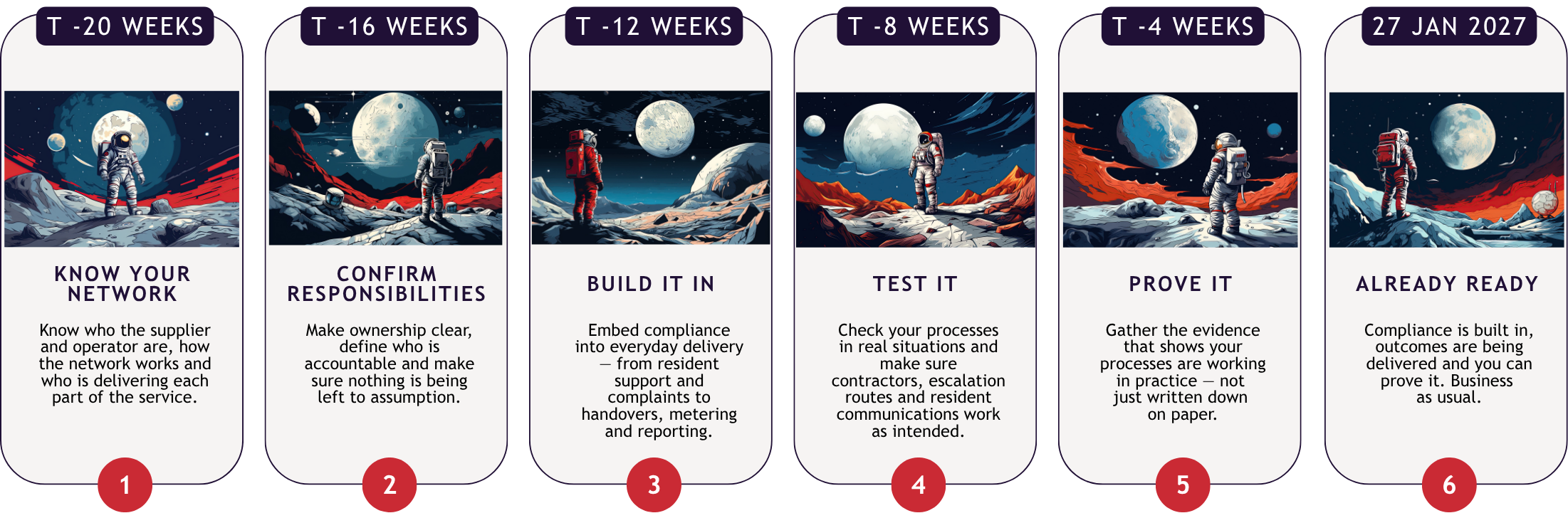
Our top tip?
Before the countdown reaches zero, make sure you can answer all five questions for every heat network you manage:
-
Who is the supplier?
-
Who is the operator?
-
Who is responsible for each consumer obligation?
-
What are we doing to protect residents and deliver the four outcomes?
-
Where is the evidence?
If answers to any of those questions are unclear, that’s the work that needs doing now.
Because the 27th January isn’t really the finish line. It’s another step into a new era for heat networks as a fully regulated utility.
The aim over the next 20 weeks isn’t to create another layer of administration. It’s to make sure everyone knows who owns what, residents know where to go, contractors know what good looks like and, when something goes wrong, everyone knows what happens to get it fixed.
If you can demonstrate those things with real evidence, compliance becomes the outcome of a well-run heat network – not a separate administrative exercise.
And when the countdown finally reaches zero?
You’re already ready.
Need some help with your countdown?
We’ve created The Final Countdown. Your Essential Pocket Guide to Ofgem Compliance – a practical guide to help you focus on what matters between now and January.
Built around Know it. Build it. Prove it. The guide covers the key areas to get right, from responsibilities and resident protection to metering, reporting, tariffs and preparing for HNTAS.