
The Heat Network Compliance Companion Playbook for Property Managers
Getting You Ready for Ofgem’s New Heat Network Rules
Heat networks are now regulated.
That changes everything.
With Ofgem appointed as the heat network regulator under the Energy Act 2023, property managers, operators and suppliers are entering a new era of formal oversight, defined responsibilities, and enforceable standards. Heat network compliance is now a formal regulatory responsibility.
The Heat Network Compliance Playbook is a practical guide designed to help senior property managers, operations teams and compliance leads understand what’s changed, what’s coming next, and how to stay compliant without losing control of cost, performance or resident experience.
This page gives you a clear overview of what heat network compliance really means, and how to navigate it confidently.

THE BACKGROUND
Why Heat Networks Are Now Regulated
Heat networks were historically unregulated, despite serving thousands of residents with no alternative choice of supplier.
That has changed.
Under the Energy Act 2023:
• Ofgem has been appointed as the regulator for heat networks
• Suppliers and operators must meet defined Authorisation Conditions
• Consumer protection, transparency and performance are now enforceable
• Non-compliance will carry regulatory and financial consequences
For property managers, this is no longer a “technical issue”. It’s a governance, reputational and operational responsibility.
The Four Pillars of Heat Network Compliance
Successful compliance is not about ticking boxes.
It relies on four connected pillars working together.
Meter It.
Meeting heat network metering requirements is essential for fair billing. Accurate, reliable metering underpins everything:
• Fair billing
• Performance monitoring
• Regulatory reporting
• Resident trust
You can’t manage what you can’t measure. Poor data quality is one of the biggest compliance risks for heat networks today.
Bill It.
Billing must now be:
• Transparent
• Understandable
• Justifiable
• Based on accurate data (actual reads)
• Quarterly
Ofgem and heat network billing regulations place new expectations on transparency and a real emphasis on fairness and clarity for end users, not just system capability.
Maintain It.
Heat networks fall within wider building safety and asset management responsibilities.
Maintenance is no longer just about uptime. You need to ensure your maintenance and reporting covers:
-
Legal obligations: compliance with health & safety legislation, metering & billing regulations, and Ofgem oversight
-
Golden Thread: maintenance creates the evidence base regulators and residents will rely on
-
Efficiency & cost control: poorly maintained systems waste energy and inflate bills
-
Resident trust: transparent records and rapid response to issues build confidence
-
Risk management: avoid fines, reputational damage, and costly emergency repairs
It’s about demonstrating control, competence, compliance and accountability across the lifecycle of the system, while balancing resident expectations and costs.
Manage It.
Real-time insights and regular reporting can transform heat network management – giving you visibility, confidence and control.
Continuous monitoring helps you:
• Spot inefficiencies before they escalate into costly failures
• Benchmark performance across multiple sites
• Track compliance against HNTAS KPIs
• Reduce avoidable callouts and disruption
• Build trust through transparency and data-led decision-making
This includes alignment with frameworks such as HNTAS and preparation for future enforcement.

About Data Energy
KEY MILESTONES
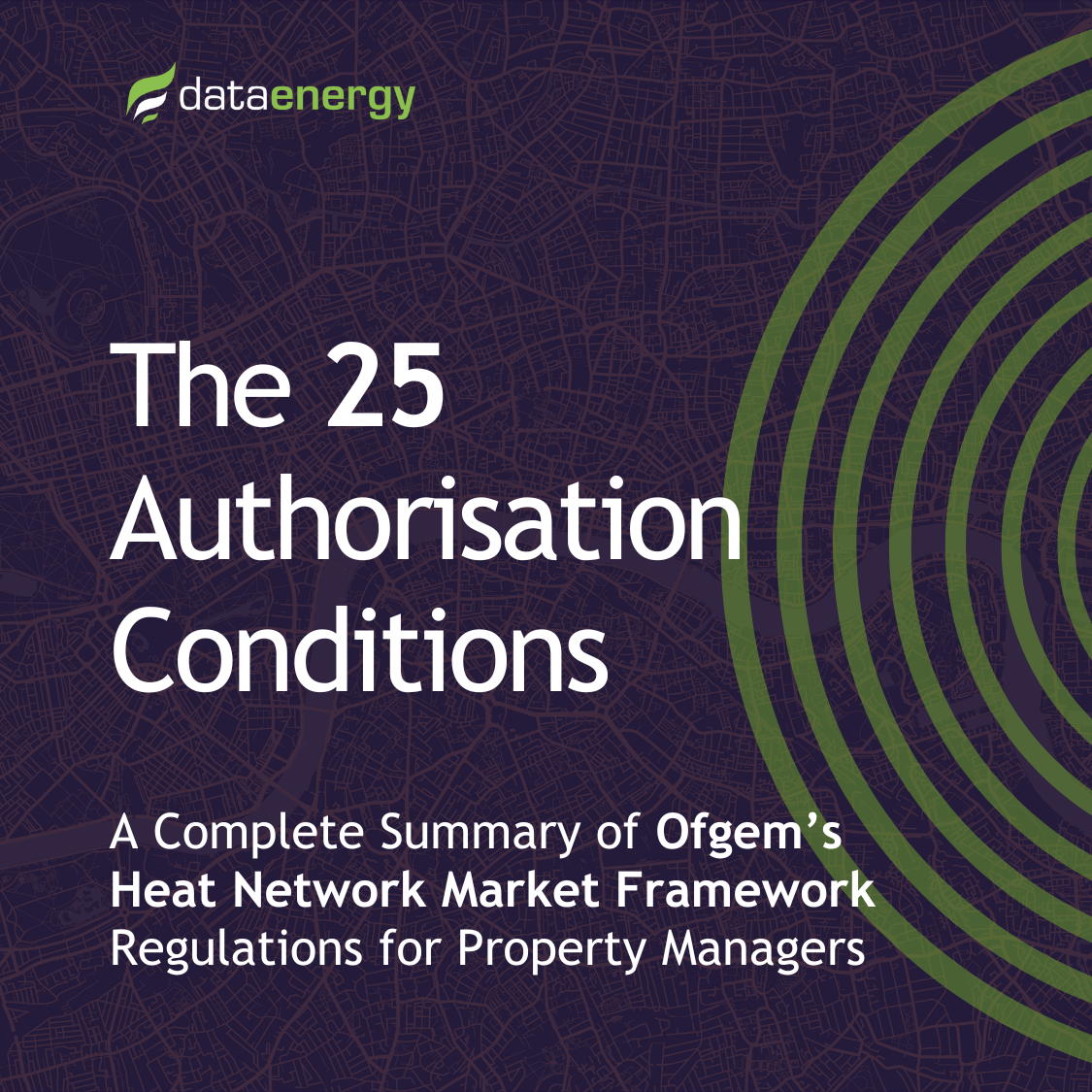
The Regulatory Journey: From Now to Enforcement
Heat network regulation is being introduced in phases.
Key milestones include:
• Deemed authorisation
• Formal registration and reporting
• Ongoing compliance monitoring
• Enforcement and penalties for non-compliance
Understanding where you are on this journey is critical. Waiting until enforcement begins is a high-risk strategy.
JUST RELEASED
The 25 Authorisation Conditions: Explained
The Heat Network Market Framework Regulations (HNMFR) introduce 25 Authorisation Conditions that all heat network suppliers and operators must meet.
They set clear requirements for behaviour, transparency and governance. These are not optional best practice – they are conditions of authorisation.
We’ve created a practical summary that brings all 25 conditions together in one clear reference for operators and property managers – to help keep your buildings safe, compliant and future-ready.
Key Milestones: Ofgem & DESNZ Timeline
Common Compliance Risks for Property Managers
From our experience, the biggest risks include:
• Incomplete or missing handover information
• Unclear supplier and operator responsibilities
• Inaccurate or unreliable metering data
• Legacy billing structures that don’t meet new expectations
• Limited visibility of plant performance
• Reactive rather than planned maintenance
These issues are common, but they are solvable with the right approach.
Who this Compliance Companion is for
This guide is designed for:
• Senior Property Managers responsible for residential portfolios
• Operations teams overseeing heat network performance
• Compliance leads managing regulatory risk
• Managing agents acting on behalf of heat network suppliers or operators
For property manager heat networks, compliance is no longer optional. If you are involved in decision-making, contractor management, billing oversight or resident communication, this applies to you.
FAQs
What is heat network compliance?
Heat network compliance is the process of meeting the legal, technical and consumer protection requirements that apply to heat networks under the Energy Act 2023 and Ofgem regulation. This includes obligations around metering accuracy, billing transparency, maintenance, performance monitoring and communication with residents.
Are heat networks now regulated?
Yes. Heat networks in England and Wales are now regulated under the Energy Act 2023, with Ofgem appointed as the regulator. Regulation is being introduced in phases, with full enforcement expected from January 2027.
Who is responsible for heat network compliance?
Primary responsibility sits with the heat network supplier and operator. However, property managers often have significant oversight responsibilities, including appointing contractors, reviewing performance, managing billing processes and communicating with residents.
What is heat network authorisation?
Heat network authorisation is the process by which suppliers and operators are approved by Ofgem to operate legally. Authorisation comes with conditions that must be met on an ongoing basis, not just at the point of application.
What are the main compliance risks for property managers?
Common compliance risks include poor-quality metering data, unclear roles and responsibilities, incomplete handover information, legacy billing structures, limited performance monitoring and inadequate record keeping.
Does the Building Safety Act apply to heat networks?
Yes. Heat networks form part of a building’s wider systems. Maintenance, safety management, competence and record-keeping obligations under the Building Safety Act may apply, particularly in higher-risk residential buildings.
What is HNTAS?
HNTAS stands for the Heat Network Technical Assurance Scheme. It sets standards for the technical performance of heat networks and is closely aligned with regulatory expectations around efficiency, reliability and consumer protection.
How can property managers prepare for heat network regulation?
Property managers can prepare by understanding their role, reviewing metering and billing data quality, assessing maintenance records, identifying gaps in handover information and putting structured oversight arrangements in place.
Where can I find practical guidance on heat network compliance?
The Heat Network Compliance Companion Playbook provides practical guidance, explanations and tools to help property managers, operations teams and compliance leads navigate regulation confidently.
JUST UPDATED
What’s Inside The Heat Network Compliance Companion Playbook
The full Playbook covers:
• The regulatory framework in plain English
• Roles, responsibilities and accountability
• Handover requirements and common gaps
• Metering and billing best practice
• Maintenance and safety considerations
• Performance monitoring and KPIs
• Tariffs and cost transparency
• The resident experience
• Practical tools, checklists and guidance
Practical Next Steps
If you do nothing else:
1. Understand whether you are acting as a supplier, operator, or both
2. Review the quality of your metering and billing data
3. Assess whether your maintenance records would stand up to scrutiny
4. Identify gaps in handover information
5. Put a plan in place now, not later
The Compliance Companion Playbook is designed to help you do exactly that.
Compliance Insights + Analysis
Our experts regularly break down what the regulations really mean in practice – and what to watch out for:

The Final Countdown: Taking heat network compliance from conversation to action
Real people. Real industry conversations. And five key questions every property manager should be asking. We took The Final Countdown on the road to The Property Institute’s Annual Conference in London on 8th October. Our own Jessica Warwick and Katherine Baker were...

The Final Countdown: Ready on Paper. Ready in Practice?
This article on heat network compliance is written by Katherine Baker, Business Operations Manager, Data Energy - and features in the AQD Autumn 2026 issue from The Property Institute. Two years ago I wrote an article for AQD called 'Mind the Gap'. Back then, much of...
What High VWART is Trying to Tell You | Maintain it
Maintain It champions preventative maintenance, helping operators spot small issues early so they can keep heat networks running efficiently and avoid costly reactive repairs. He has a simple philosophy. Don't wait for something to break. By the time a pump fails or a...
Resources

Resources: Total Heat and Energy Management
Looking for a Total Heat and Energy Management Provider? Our partner company, DMG Delta is a leading provider of heat network maintenance, engineering and support services for you and your residents. Together, we now offer a complete solution for your heat...

Resources: Get Ofgem Compliant
Get Ofgem Compliant Preparing your heat networks for the new regulationsData Energy

Resources: Partnering with You
Partnering with You Discover our range of energy services - download our brochure.Data Energy
Latest News
The Final Countdown: Taking heat network compliance from conversation to action
Real people. Real industry conversations. And five key questions every property manager should be asking. We took The Final Countdown on the road to The Property Institute’s Annual Conference in London on 8th October. Our own Jessica Warwick and Katherine Baker were...
The Final Countdown: Ready on Paper. Ready in Practice?
This article on heat network compliance is written by Katherine Baker, Business Operations Manager, Data Energy - and features in the AQD Autumn 2026 issue from The Property Institute. Two years ago I wrote an article for AQD called 'Mind the Gap'. Back then, much of...

Electricity VAT is Changing | What you Need to Know
Electricity VAT is changing from 1st October 2026. From 1st October 2026 to 31st March 2027, qualifying residential electricity supplies that are currently charged at 5% VAT will temporarily move to 0% VAT.What does this mean for you?If you manage residential...
Useful Links

The Energy Ombudsman
The Energy Ombudsman is a free, independent UK service that resolves disputes between energy companies and customers. It handles complaints about billing, service, and supply issues, providing impartial mediation. It can require companies to fix problems, apologize,...
CIBSE CP1 – Code of Practice
CIBSE CP1 (2020) provides guidance on the design, operation, and management of heat networks in the UK. It aims to improve efficiency, reduce carbon emissions, and ensure reliable performance. The guidance covers best practices for planning, commissioning, and...

Building Safety Act
The Building Safety Act 2022 improves building safety in the UK, focusing on high-risk structures. It strengthens regulations, establishes the Building Safety Regulator, and mandates accountability for developers. The Act aims to prevent future tragedies like Grenfell...

Energy Act 2023 Guidance
The Energy Act 2023 promotes energy security and affordability in the UK, encouraging investment in renewable energy, enhancing grid resilience, and supporting nuclear and hydrogen projects. It also seeks to modernize energy markets and reduce carbon emissions,...

Heat Network (Metering and Billing) Regulations 2014
The Metering and Billing Regulations ensure accurate energy billing and promote fairness by requiring suppliers to provide reliable meters, correct billing, and transparent information to customers. They aim to protect consumers, prevent overcharging, and improve...
WHAT WE DO
Expert Services

Metering & Billing Packages
Transparent, accurate and compliant heat network billing - backed by clear communication and friendly resident support.

Compliance & Monitoring
Complete insight and control – from plant room to apartment level.

Technical & Onsite Services
Diagnostics, meter health checks and expert investigations backed by real data.

Energy Procurement Packages
Independent procurement that secures fair, competitive rates and supports responsible budgeting.

Consultancy Services
Compliance, HNTAS, tariffs, commissioning, optimisation and design support.

Learning & Development
CPD-accredited and bespoke sessions - turning complex rules and subjects into easy-to-use, practical knowledge.
Some of our trusted clients